

Common signs
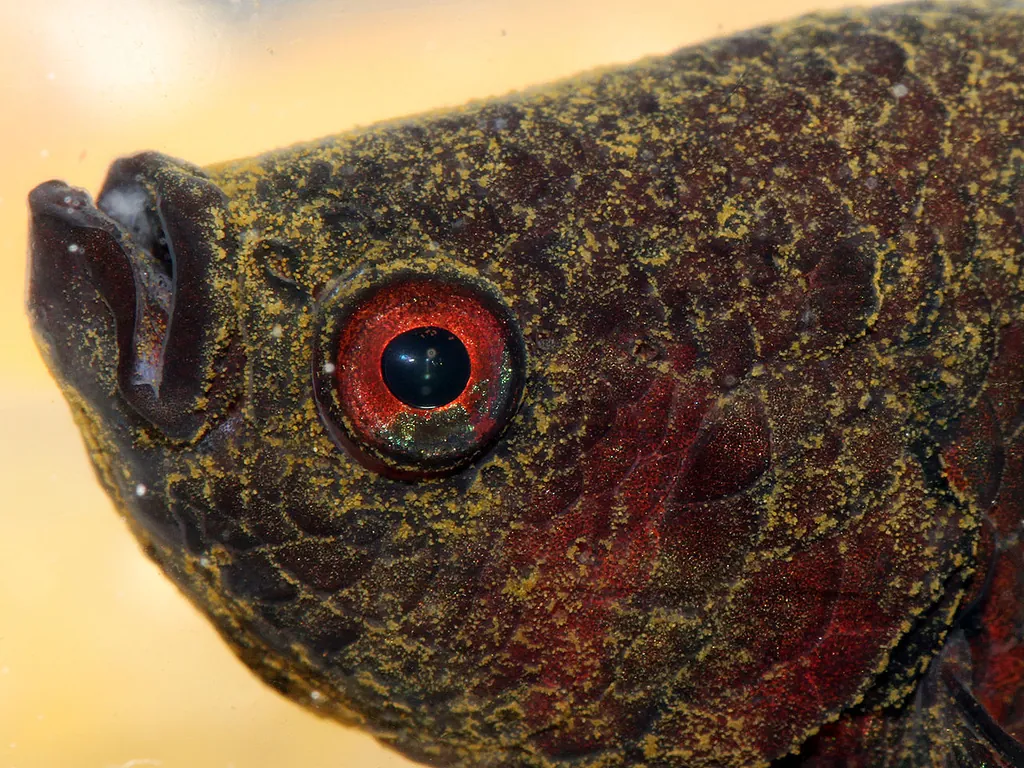
- Fine dusting or sheen on the body, sometimes easier to see with angled light.
- Rapid breathing, clamped fins, hiding, or rubbing on objects.
- Loss of appetite and staying near high-flow or surface areas.
Most useful clues
- Fine gold, rust, tan, or dusty coating visible under angled light.
- Rapid breathing, surface hanging, or staying near high flow.
- Flashing, clamped fins, hiding, or sudden appetite loss.
Emergency check
What to check first
Treat velvet-like signs with rapid breathing, surface gasping, or multiple fish declining as urgent because gill involvement can progress quickly.
- Check breathing, surface gasping, aeration, temperature, ammonia, and nitrite immediately.
- Use angled light to look for dusting once urgent water and oxygen checks are underway.
- Check whether multiple fish show breathing or irritation signs.
Possible causes
- A parasite introduced with new fish or transferred through wet equipment.
- Stress from transport, crowding, or unstable water conditions.
- Delayed detection because dusting can be subtle under aquarium lighting.
How to tell it apart
- Distinct white salt grains.
- Velvet is usually finer, dustier, and more sheen-like.
- Abnormal tests, red gills, and many fish distressed.
- No consistent dusty coating.
- Flashing, mucus, or one gill held closed.
- No gold or rust sheen under angled light.
What to check next
- Test ammonia, nitrite, nitrate, temperature, and pH, because water stress can mimic or worsen many disease signs.
- Use a flashlight at an angle to look for dusting rather than distinct salt-like dots.
- Watch breathing rate and whether multiple fish are affected.
Care steps to consider
- Treat fast breathing and spreading dusting as higher concern and get experienced help quickly.
- Compare with ich and general parasite signs before selecting a product.
- Verify treatment safety for sensitive fish, invertebrates, and plants before dosing.
Photos to take after urgent checks are underway
- Use angled flashlight or side lighting to show dusting.
- Record breathing rate and surface behavior.
- Capture fins, gill cover, and body sheen in the same session.
Common mistakes to avoid
- Waiting for obvious spots even when breathing signs are worsening.
- Confusing velvet dusting with normal iridescence or lighting glare.
Species and tank notes
- Dark fish often show dusty sheen more clearly than pale fish.
- Marine velvet and freshwater velvet involve different organisms, but both can be serious.
When to get expert help
- Rapid breathing, surface gasping, or multiple fish declining can be urgent.
- Velvet-like signs should not be ignored while waiting for clearer spots.
Prevention tips
- Quarantine new arrivals and avoid sharing wet equipment.
- Keep stress low during acclimation and maintain stable water conditions.
Related guides
Related symptoms
FAQ
Frequently asked questions
01How is velvet different from ich?+
Ich often appears as distinct white grains. Velvet may look more like fine dust or sheen and may cause breathing trouble early.
02Can a photo miss velvet?+
Yes. Velvet can be subtle, lighting-dependent, and easier to notice through behavior and breathing changes.
03Why can velvet be missed in photos?+
The coating can look like subtle dusting or shine, and gill signs may appear before the body sheen is obvious.
04What should I check before assuming velvet?+
Check ammonia, nitrite, oxygenation, breathing rate, angled-light dusting, and whether multiple fish are declining.
05What should I check first for Velvet Disease in Fish?+
Start with this check: Use angled light and check breathing immediately. Then compare the visible signs with behavior and tank history before relying on a photo match.
06When is Velvet Disease in Fish urgent?+
Treat velvet-like signs with rapid breathing, surface gasping, or multiple fish declining as urgent because gill involvement can progress quickly.
07What can look similar to Velvet Disease in Fish?+
Compare it with Ich, Ammonia or nitrite poisoning, Gill flukes or parasites. The key is to match the full pattern: body area, behavior, breathing, spread speed, and water-test context.
Fish Disease Identifier provides educational guidance and possible matches from photos. Results are not veterinary advice and may be wrong. For severe, worsening, or unclear symptoms, consult an aquatic veterinarian or experienced aquarium professional.
Review notes
Sources and limits
This guide is educational and helps narrow possible matches. It is not a veterinary diagnosis, and urgent breathing, swelling, collapse, or tank-wide distress should not wait for photo confirmation.
Read more about safety limits and educational use on the About page.
Last content review: 2026-07-01
Fish Disease Identifier
Still not sure what your fish has?
Scan a photo in Fish Disease Identifier and get likely disease matches, possible causes, and next steps to consider.
Educational only. Not veterinary advice.